OT: Turbulence

If you're boarding a plane today, you might not want to click on these. I'm a frequent flyer by no means, but I have been on a plane at least 50 times, so I don't consider myself afraid to fly. But even moderate turbulence can turn my knuckles white. Can't imagine what it was like on this plane. 1 dead and 30 injured.

I look at turbulence as getting an amusement park ride on an otherwise boring flight, and it is amusing to watch some people lose their shit over something they have no control over, once that plane door closes its in God's hands IMO. and yes to the seat belts when things are getting bumpy, I dont always keep mine on, but when its suggested, its in my best interest.
Why isn't Chuck Foreman in the Hall of Fame?

Turbulence is getting worse, possibly because of climate change. I always keep my seat belt on.
https://www.frommers.com/tips/airfare/how-dangerous-is-turbulence-on-planesand-is-it-getting-worse
VikingOracle wrote:
Turbulence is getting worse, possibly because of climate change. I always keep my seat belt on.https://www.frommers.com/tips/airfare/how-dangerous-is-turbulence-on-planesand-is-it-getting-worse
Yeah, definitely climate change. lol "Turbulence is getting worse". Please show the study.
"Possibly because of climate change". Again, show the study... lol
I love this kind of speculation. It's how Covid took on a life of its own.
VikingOracle wrote:
Turbulence is getting worse, possibly because of climate change. I always keep my seat belt on.https://www.frommers.com/tips/airfare/how-dangerous-is-turbulence-on-planesand-is-it-getting-worse
if it was indeed being experienced more, I would guess it is a due to more confidence in the aircraft's abilities to handle flying through weather instead of around it, or having the flights grounded all together.
Why isn't Chuck Foreman in the Hall of Fame?

VikingOracle wrote:
Turbulence is getting worse, possibly because of climate change. I always keep my seat belt on.https://www.frommers.com/tips/airfare/how-dangerous-is-turbulence-on-planesand-is-it-getting-worse
FFS

The data doesn't actually support any statistical change in turbulence over the years according to the NTSB. From their own slides, the data below shows events from 1998 to 2013. That averages to just over 14 serious events per year in that period.
Year Events Serious Minor
2013 11 3 37
2012 33 10 83
2011 26 19 32
2010 13 11 73
2009 21 15 106
2008 12 12 43
2007 11 12 10
2006 28 9 49
2005 33 9 42
2004 36 12 50
2003 36 24 83
2002 29 14 74
2001 33 17 53
2000 40 21 82
1999 36 16 181
1998 34 22 111
16 432 225 1,109
Also from the NTSB, there were 146 serious events from 2009 - 2021 or about 13.3 events per year.
That looks like a normal statistical spread of the number of serious events from 1998 to 2021. There's no later data yet. I'm not sure what it would mean anyway as the pandemic shut down most flying....which would cause the numbers to rise post pandemic to pre pandemic levels. Some years are worse than others. About 80% of the serious injuries are Flight Attendants.
So..not much has changed for the actual data. What has accelerated over the years is that every serious weather event is automatically tied to Climate Change. We had the fewest tornadoes recorded in the US ever in 2013...but we don't talk about that...we talked about the single tornado that caused significant damage and loss of life as proof positive of Climate Change. https://www.usatoday.com/story/weather/2013/05/09/quiet-tornado-season/2148075/
We don't talk about the unprecedented 10 year period with no CAT 3 or higher Hurricanes hitting the US...but we will certainly talk about subsequent singular events as proof positive of Climate Change related events. https://svs.gsfc.nasa.gov/12251/#:~:text=It%20has%20been%20a%20decade,along%20only%20every%20270%20years.
JimmyinSD wrote:
if it was indeed being experienced more, I would guess it is a due to more confidence in the aircraft's abilities to handle flying through weather instead of around it, or having the flights grounded all together.
Either that or it’s because save the pandemic years we fly more flights year over year every year.
JimmyinSD wrote:
if it was indeed being experienced more, I would guess it is a due to more confidence in the aircraft's abilities to handle flying through weather instead of around it, or having the flights grounded all together.
Either that or it’s because save the pandemic years we fly more flights year over year every year.
I was on a flight into Denver a number of years ago that dropped 1000 feet during approach. Everybody was buckled in so no injuries. It scared the crap out of everybody. Lots of screaming and crying. We actually made the Denver news. I fly all the time so usually don't even notice turbulence...but I noticed that one..
badgervike wrote:
I was on a flight into Denver a number of years ago that dropped 1000 feet during approach. Everybody was buckled in so no injuries. It scared the crap out of everybody. Lots of screaming and crying. We actually made the Denver news. I fly all the time so usually don't even notice turbulence...but I noticed that one..
Multiply that times six and that's how much the Singapore flight dropped.
Because of the mountains, moderate turbulence is a pretty regular thing flying into Denver, but I haven't experienced anything that goes beyond what it's like riding in the back of a pickup on a road strewn with potholes. But I have a pilot friend who says that the skies above Denver are some of the most challenging.
MaroonBells wrote:
Multiply that times six and that's how much the Singapore flight dropped.
Because of the mountains, moderate turbulence is a pretty regular thing flying into Denver, but I haven't experienced anything that goes beyond what it's like riding in the back of a pickup on a road strewn with potholes. But I have a pilot friend who says that the skies above Denver are some of the most challenging.
Yea...I've been into DIA and Stapleton prior at least 100 times so well aware of the normal turbulence into Denver. It normally doesn't even phase me. I've had people kiss the ground in front of me after flights because of turbulence...that I didn't even register as bad. The Singapore flight at least nosed down. We literally dropped out of the sky just like dropping something off a high platform and all of a sudden stopped dropping. There was a lot of screaming going on.
the best turbulence i have experienced was also flying into Denver, small plane got jacked around pretty good, me and a US Marshall just laughed because there wasnt a damn thing we could do but wait and see how it ended, a few others experienced other emotions.
Why isn't Chuck Foreman in the Hall of Fame?
StickierBuns wrote:
The flight from Denver to Colorado Springs was always known as the "Vomit Comet".....
As bad as that airport in Aspen that seems to be about 100 feet long? I don't know how long it actually is..but you bump and bounce and come into that short mountainous runway at a steep altitude with the brakes on hard immediately.
StickierBuns wrote:
The flight from Denver to Colorado Springs was always known as the "Vomit Comet".....
I believe it. I did that flight a few months ago, which might seem odd considering it's an hour drive. But the weather was so bad in Denver on our return trip from Hawaii, the plane ended up circling for about an hour and had to divert to the Springs to refuel.
You guys really didn't think I had studies to back this up?
https://link.springer.com/article/10.1007/s00382-023-06694-x#Abs1
https://agupubs.onlinelibrary.wiley.com/doi/10.1029/2023gl103814
https://link.springer.com/article/10.1007/s42797-021-00036-y
https://time.com/6980525/singapore-airlines-flight-london-bangkok-severe-turbulence-dead-injured/ "A study by Reading University published in 2023 said that clear air turbulence, which is invisible, had increased with climate change."
https://link.springer.com/content/pdf/10.1007/s00376-017-6268-2.pdf
https://agupubs.onlinelibrary.wiley.com/doi/pdf/10.1002/2017GL074618
https://www.cbc.ca/news/world/turbulence-deaths-flights-1.7209671
https://www.bbc.com/news/science-environment-65844901
It is actually really shocking to me is my post resulting in a FFS. Do people really think climate change might not result in more turbulence?
VikingOracle wrote:
You guys really didn't think I had studies to back this up?https://link.springer.com/article/10.1007/s00382-023-06694-x#Abs1
https://agupubs.onlinelibrary.wiley.com/doi/10.1029/2023gl103814
https://link.springer.com/article/10.1007/s42797-021-00036-y
https://time.com/6980525/singapore-airlines-flight-london-bangkok-severe-turbulence-dead-injured/ "A study by Reading University published in 2023 said that clear air turbulence, which is invisible, had increased with climate change."
https://link.springer.com/content/pdf/10.1007/s00376-017-6268-2.pdf
https://agupubs.onlinelibrary.wiley.com/doi/pdf/10.1002/2017GL074618
https://www.cbc.ca/news/world/turbulence-deaths-flights-1.7209671
https://www.bbc.com/news/science-environment-65844901
It is actually really shocking to me is my post resulting in a FFS. Do people really think climate change might not result in more turbulence?
So...we shouldn't actually use the data on severe turbulence injuries as reported by the NTSB? Got it. There's some problems in your "science". Most of it refers to the same "study". First of all, anybody that thinks they can calculate / predict turbulence in years 2050 through 2080 should be discounted as with many of the other weather projections which don't come to fruition. The 55% "increase" in severe turbulence events is all tied to the year 1979. As you can see from the NTSB data I posted, there is a lot of variability from year to year. I'll dig around for the data but I'm going to guess 1979 was a low year for severe turbulence events. Let's take a look at it the other direction. If I cherry pick the data from the NTSB reporting in years 1998 to 2013, you'll find a decrease of 86% between those reporting years (22 vs 3). So..given the first year in that reporting and the last year, I could say that turbulence was down by 86% knowing full well that isn't indicative of the facts. As I said, the data is variable but consistent throughout the years 1998 to 2021.
Every year we get projections of the worst situation ever...tornadoes, hurricanes, heat, ocean levels etc. yet more often than not those projections are wrong.
As we sit here today, the Artic Ice Pack is just inside the 43 year Interdecile range...meaning the gloom and doom of the settled science hasn't been as drastic as projected.
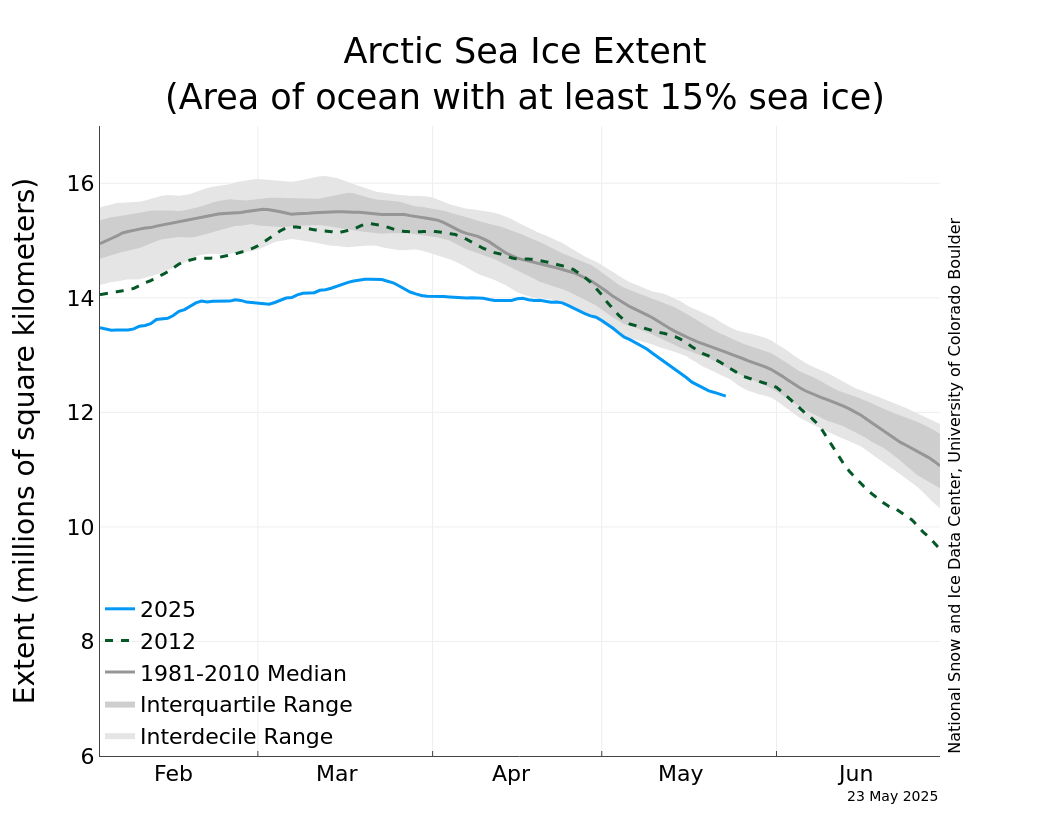
Be a good shepherd of the environment, it's the only one we have. But let's not pretend we know everything about climate change and that all these unrealized projections come from settled science. No science is ever settled. It just incorporates information known at the time.
Actually Badger, I give you props on actually posting facts to support your argument unlike your cohorts who go right to the personal insults. I looked at the NTSB report as I found what you posted to be interesting. The problem I had in that report was that it was not about whether there is or is not more turbulence (or the cause, if so) but how best to mitigate injuries caused by turbulence. From the report, it is clear the NTSB has been proposing things for decades to prevent inflight injuries, some have been implemented, some have not. I assume the fact that the incidence of injuries has somewhat been impacted by the safety recommendations implemented in the past decade. However, as that report did not address whether past safety changes has in fact reduced injuries, it is hard to really rely on the # of injuries as reflecting the incidence of turbulence. Additionally, bigger, newer planes are better designed to handle turbulence and minimize passenger injury (https://monroeaerospace.com/blog/why-bigger-airplanes-experience-less-turbulence/) and your facts do not take into account the improvement in and the growth in size of commercial airplanes. But again, I highly respect that you posted actual facts. BTW, I think I posted 4 separate studies and a bunch of articles that cite those articles (though principally the Reading study) -- they are not all posting to a single scientific article). I do welcome you finding and posting a scientific article that refutes these 4 scientific articles).
I think you and I can also agree that JimmyinSD's statement, "if it was indeed being experienced more, I would guess it is a due to more confidence in the aircraft's abilities to handle flying through weather instead of around it" is simply wrong. As I am sure you noted, many of NTSB's recommendations related to sharing of information by airlines, etc. in order for plane en route to avoid turbulence. For instance, in 1998, NTSB recommended that the airlines re-emphasize the importance of reporting turbulence so other flights could avoid it (NTSB 98A-98-105) and this was actually implemented by the FAA in 2002. In fact, I am guessing (but have no study to support this) that airlines are much better able to avoid turbulence than they were even a decade ago.
I also want to note as to tornadoes, I think we can agree that the science does not support that climate change increases their frequency. In fact, climate change may suppress tornadoes. https://education.nationalgeographic.org/resource/tornadoes-and-global-warming-there-connection/
Also, please note, I only said climate change was a "possible" cause of increased turbulence -- I would hope that you would agree that is a reasonable thing to say -- unless you think it is impossible that there is an actual increase in turbulence. If so, you may want to review this: https://agupubs.onlinelibrary.wiley.com/doi/10.1029/2023gl103814.
Again, I respect the way to countered my statement (which I did not find to be controversial when posted though naive of me not to think the term "climate change" would not be triggering). I did not wish to engage in an argument and I apologize if I offended other posters here by saying that something was a possible cause.
VikingOracle wrote:
Actually Badger, I give you props on actually posting facts to support your argument unlike your cohorts who go right to the personal insults. I looked at the NTSB report as I found what you posted to be interesting. The problem I had in that report was that it was not about whether there is or is not more turbulence (or the cause, if so) but how best to mitigate injuries caused by turbulence. From the report, it is clear the NTSB has been proposing things for decades to prevent inflight injuries, some have been implemented, some have not. I assume the fact that the incidence of injuries has somewhat been impacted by the safety recommendations implemented in the past decade. However, as that report did not address whether past safety changes has in fact reduced injuries, it is hard to really rely on the # of injuries as reflecting the incidence of turbulence. Additionally, bigger, newer planes are better designed to handle turbulence and minimize passenger injury (https://monroeaerospace.com/blog/why-bigger-airplanes-experience-less-turbulence/) and your facts do not take into account the improvement in and the growth in size of commercial airplanes. But again, I highly respect that you posted actual facts. BTW, I think I posted 4 separate studies and a bunch of articles that cite those articles (though principally the Reading study) -- they are not all posting to a single scientific article). I do welcome you finding and posting a scientific article that refutes these 4 scientific articles).I think you and I can also agree that JimmyinSD's statement, "if it was indeed being experienced more, I would guess it is a due to more confidence in the aircraft's abilities to handle flying through weather instead of around it" is simply wrong. As I am sure you noted, many of NTSB's recommendations related to sharing of information by airlines, etc. in order for plane en route to avoid turbulence. For instance, in 1998, NTSB recommended that the airlines re-emphasize the importance of reporting turbulence so other flights could avoid it (NTSB 98A-98-105) and this was actually implemented by the FAA in 2002. In fact, I am guessing (but have no study to support this) that airlines are much better able to avoid turbulence than they were even a decade ago.
I also want to note as to tornadoes, I think we can agree that the science does not support that climate change increases their frequency. In fact, climate change may suppress tornadoes. https://education.nationalgeographic.org/resource/tornadoes-and-global-warming-there-connection/
Also, please note, I only said climate change was a "possible" cause of increased turbulence -- I would hope that you would agree that is a reasonable thing to say -- unless you think it is impossible that there is an actual increase in turbulence. If so, you may want to review this: https://agupubs.onlinelibrary.wiley.com/doi/10.1029/2023gl103814.
Again, I respect the way to countered my statement (which I did not find to be controversial when posted though naive of me not to think the term "climate change" would not be triggering). I did not wish to engage in an argument and I apologize if I offended other posters here by saying that something was a possible cause.
We're all good Oracle. I think healthy respectful conversation is a good thing. I was simply reacting to yet another weather phenomenon linked to "possible" Climate Change. That was certainly the assumptions behind that study with it's projections well out to 2080. We had tornadoes and severe weather last night here in Madison....and the corresponding pleas for addressing Climate Change this morning from the local news outlets (we're heavy duty Team Blue in these parts). As you are aware, virtually every weather event comes with the litany of Climate Change proclamations.
One note, I actually think planes are getting smaller / lighter in aggregate in the US. Certainly, new planes are using lighter titanium structures and fly by wire technology to reduce weight and increase fuel efficiency. Many of the US carriers have also significantly increased reliance on smaller commuter jets / routes versus the traditional hub and spoke routes and larger planes. That would make them more susceptible to turbulence and mitigate some of the other improvements in identifying turbulent areas.
VikingOracle wrote:
Actually Badger, I give you props on actually posting facts to support your argument unlike your cohorts who go right to the personal insults. I looked at the NTSB report as I found what you posted to be interesting. The problem I had in that report was that it was not about whether there is or is not more turbulence (or the cause, if so) but how best to mitigate injuries caused by turbulence. From the report, it is clear the NTSB has been proposing things for decades to prevent inflight injuries, some have been implemented, some have not. I assume the fact that the incidence of injuries has somewhat been impacted by the safety recommendations implemented in the past decade. However, as that report did not address whether past safety changes has in fact reduced injuries, it is hard to really rely on the # of injuries as reflecting the incidence of turbulence. Additionally, bigger, newer planes are better designed to handle turbulence and minimize passenger injury (https://monroeaerospace.com/blog/why-bigger-airplanes-experience-less-turbulence/) and your facts do not take into account the improvement in and the growth in size of commercial airplanes. But again, I highly respect that you posted actual facts. BTW, I think I posted 4 separate studies and a bunch of articles that cite those articles (though principally the Reading study) -- they are not all posting to a single scientific article). I do welcome you finding and posting a scientific article that refutes these 4 scientific articles).I think you and I can also agree that JimmyinSD's statement, "if it was indeed being experienced more, I would guess it is a due to more confidence in the aircraft's abilities to handle flying through weather instead of around it" is simply wrong. As I am sure you noted, many of NTSB's recommendations related to sharing of information by airlines, etc. in order for plane en route to avoid turbulence. For instance, in 1998, NTSB recommended that the airlines re-emphasize the importance of reporting turbulence so other flights could avoid it (NTSB 98A-98-105) and this was actually implemented by the FAA in 2002. In fact, I am guessing (but have no study to support this) that airlines are much better able to avoid turbulence than they were even a decade ago.
I also want to note as to tornadoes, I think we can agree that the science does not support that climate change increases their frequency. In fact, climate change may suppress tornadoes. https://education.nationalgeographic.org/resource/tornadoes-and-global-warming-there-connection/
Also, please note, I only said climate change was a "possible" cause of increased turbulence -- I would hope that you would agree that is a reasonable thing to say -- unless you think it is impossible that there is an actual increase in turbulence. If so, you may want to review this: https://agupubs.onlinelibrary.wiley.com/doi/10.1029/2023gl103814.
Again, I respect the way to countered my statement (which I did not find to be controversial when posted though naive of me not to think the term "climate change" would not be triggering). I did not wish to engage in an argument and I apologize if I offended other posters here by saying that something was a possible cause.
The problem with your argument is that you just make an assertion out of the blue that's old and stale and supported and lied about by those who want it to be the narrative. Every time happens, it's racism, climate change, or the Orange Man. It gets to the point that the assertions are so stupid that people get tired of proving they're stupid.
well since this is going from bumping our heads to political fodder, I am going to just assume this one is headed for the shitter and move it over to the ST board.
Why isn't Chuck Foreman in the Hall of Fame?
Waterboy wrote:
The problem with your argument is that you just make an assertion out of the blue that's old and stale and supported and lied about by those who want it to be the narrative. Every time happens, it's racism, climate change, or the Orange Man. It gets to the point that the assertions are so stupid that people get tired of proving they're stupid.
How could it not. As soon as it had anything to do with earth, it had to be climate change, and thus a Sensitive Topic. lol. Zanary, you are simply a sheeple.
Edit Post (mod action — author will see a notice)
Warn Poster
Suspend User (3 days)
The user will be suspended for 3 days and will receive an email with the reason and information about how to appeal.